
Address: PO Box 313, Oudtshoorn, 6620
Oudtshoorn Research Farm, Old Kamanassie Road, Oudtshoorn
Tel: 044 203 9404
Email: Stefan.Engelbrecht@westerncape.gov.za
GPS co-ordinates: 33.63171812 S 22.257136808 E
Oudtshoorn Research Farm
Located in the Klein Karoo, The Oudtshoorn Research Farm is about 8km outside Oudtshoorn in the Eden district. This 843 hectare farm has an annual rainfall of approximately 230mm and focuses on research for the ostrich industry, the main agricultural enterprise in the region. It is the world’s first dedicated ostrich research farm, established in 1964 and remains an important local and international resource for ostrich research. The research farm serves the agricultural community through the provision of necessary support services. Key services are provided by five departmental programmes with diverse, yet integrated responsibilities towards service delivery.
About us
The ostrich research team comprises of local and international scientists, technicians and students. Dr Anel Engelbrecht’s research focuses on improving leather quality, specifically the incidence and extent of pitting on ostrich skins in the South African ostrich leather industry. Dr Zanell Brand do research on the artificial incubation of ostrich eggs as well as embryonic development. This also include aspects like animal reproduction, welfare and behaviour.. Ostrich breeding research has been pioneered by Prof. Schalk Cloete, whose work on genetic selection has resulted in genetic gains for all major traits of economic importance in ostriches, including:
- Reproduction
- Chick survival
- Growth
- Qualitative and quantitative slaughter traits
- Mature live weight as well as feather dimensions and weight
He is now retired but still gives value inputs to the ostrich research program. Researchers from local and international universities also have active projects on the farm, in collaboration with researchers from the Directorate: Animal Sciences. The following projects based at the Oudtshoorn Research Farm are collaborations with international scientists and local universities:
- Breeding group composition, sex ratio, genetic compatibility, mate selection
- Investigation into steroidogenesis in the ostrich and improving ostrich welfare through developing good human-bird interaction practices. The researchers also work closely with the industry to ensure that research remains relevant
While the research at the Oudtshoorn Research Farm is primarily focused on ostriches, several crops have been cultivated and investigated on the farm. Alternative crops including figs, prickly pears and jojobas are grown on the farm. The farm produces about 800 tons of alfalfa annually and mainly uses of flood irrigation. The farm also hosts other departmental programmes: Structured Agricultural Education and Training, Veterinary Services, Sustainable Resource Management, Farmer Support and Development and Rural Development Coordination that work together to support the agricultural community as a whole.
Oudtshoorn resource flock
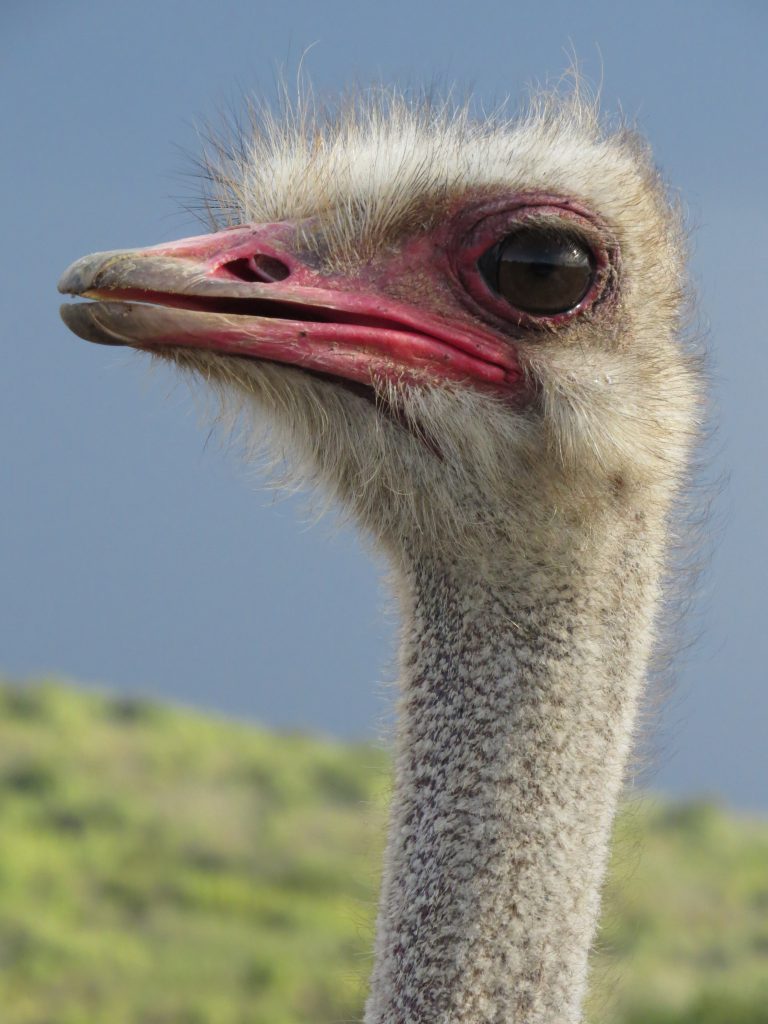
The farm houses the biggest ostrich research unit in the world. Three registered ostrich units are located at the farm: an export registered slaughter production unit where chicks are reared to slaughter age, a breeding farm hosting the breeding flock, and a hatchery where eggs are artificially incubated.
Central to the research programme, is the ostrich breeding flock of approximately 400 birds. The breeding programme on the farm has been running since 1990. The breeding research aims to improve productivity and product quality through genetic improvement. The flock consists of South African Black (Struthio camelus var. domesticus) ostriches.
From 1996 separate breeding lines for egg production and body weight were introduced. Since then, other traits of economic importance, such as leather and feather quality have also been added as breeding objectives.
Single pair mating is applied in the ostrich research flock to monitor individual productivity. Eggs are collected and artificially incubated at the on-farm hatchery.
The chicks are used in research trails, slaughtered for research purposes, or kept for breeding purposes. Data from the flock is meticulously recorded throughout the production process for research purposes. All aspects of the ostrich production cycle are recorded, starting with the identification of each egg and chick by means of a unique number. Careful record keeping during slaughter ensures that every carcass and skin can be traced back to the individual ostrich. Data is also used for estimating breeding values for various ostrich traits of economic importance. Many of the chicks are sold day-old, while young breeder birds, selected on their breeding values, are annually auctioned to enable local producers to obtain superior breeding material for their own breeding flocks.
Research on feeding conducted on the farm assisted with the development of feeding standards and the evaluation of feedstuffs, enabling formulation of optimum rations at the lowest cost. Other fields of study explored include reproduction physiology, incubation physiology, management, welfare, rearing conditions and housing for chicks.
Various scientists, students and academic institutions are involved in the research programme and make use of the data collected from this one-of-a-kind research flock. A support team consisting of technical staff and workers are responsible for the daily maintenance of the ostrich flock, data collection and execution of research projects.
The researchers also work closely with the industry to ensure that research remains relevant. Research findings are continuously disseminated by means of lectures given at farmer’s days and congresses, publications in popular and scientific journals and magazines, and via the internet. Practical information is passed on through extension officers and interaction with clients who visit the research centre and facilities for technical advice and information. Training and education are addressed further by compiling information packages with practical up-to-date information for use by the commercial and emerging farming communities.
Ostrich Auction and information day
Oudtshoorn Research Farm hosts an annual ostrich auction; at which ostriches are sold. This enables farmers to benefit from the genetic improvement made with the research flock. Birds for these auctions are selected on breeding values for traits such as reproduction and weight.
Publications
The Volstruishandleiding and the newly updated and translated Ostrich manual summarises the existing knowledge of ostrich farming in an accessible form. The authors are all experts in their fields and have shared their knowledge and novel research findings in these publications.
Oudtshoorn Research Farm: Celebrating 50 years of the world’s first Ostrich Research Farm (1964 – 2014) documents the rich history of the Oudtshoorn Research Farm.
The Oudtshoorn Poster Book is a compilation of posters presented local and international conferences by the research team.
Research Project Summaries (2012/2013) is an overview of some of the research projects being investigated.
For more information about research at Oudtshoorn Research Farm, please view the researcher profile pages and publications section of the website.
Ostrich research
Other programmes
Celebrating 50 years of the world’s first Ostrich Research Farm (1964 – 2014) documents the rich history of the Oudtshoorn Research Farm.
While the research at the Oudtshoorn Research Farm is primarily focused on ostriches, several crops have been cultivated and investigated on the farm. Alternative crops including figs, prickly pears and jojobas are grown on the farm.
The farm also hosts other departmental programmes to support the agricultural community as a whole.
While the research at the Oudtshoorn Research Farm is primarily focused on ostriches, several crops have been cultivated and investigated on the farm. Alternative crops including figs, prickly pears and jojobas are grown on the farm. The farm produces about 800 tons of alfalfa annually and mainly uses of flood irrigation.
The farm also hosts other departmental programmes: Structured Agricultural Education and Training, Veterinary Services, Sustainable Resource Management, Farmer Support and Development and Rural Development Coordination that work together to support the agricultural community as a whole.
Meet the Oudtshoorn Research Farm team
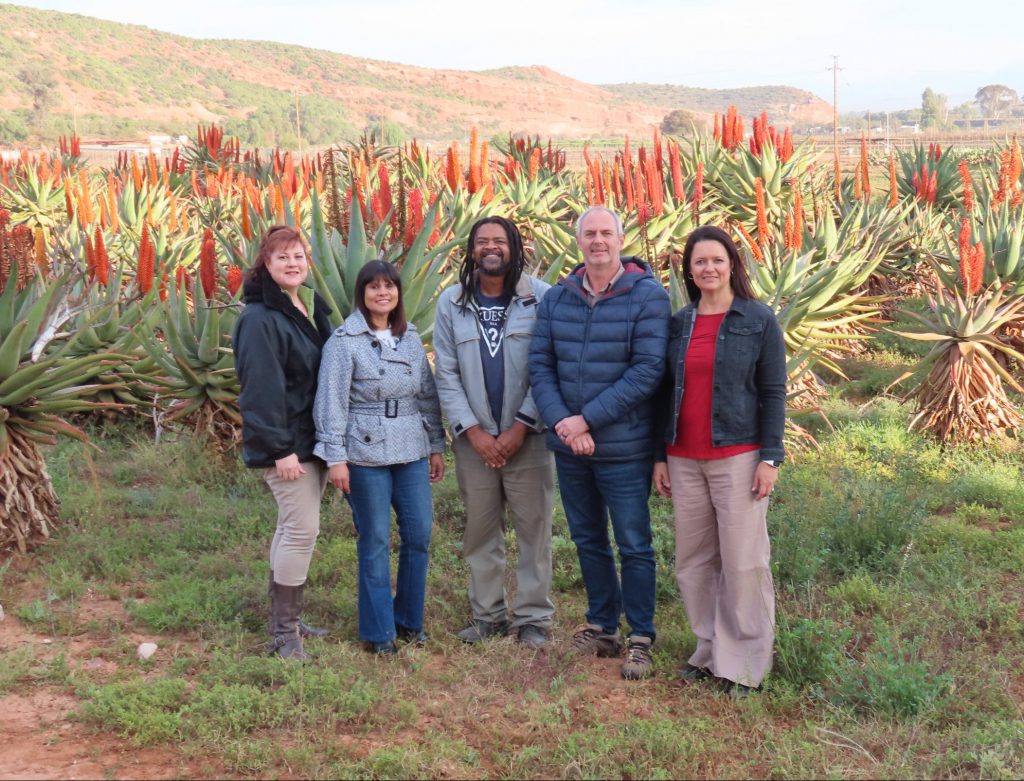
Dr Zanell Brand – Researcher, Chantel van Rooyen – Administrative clerk, Rodney Gangathele – Foreman, Stefan Engelbrecht – Research coordinator and
farm manager and Dr Anel Engelbrecht – Researcher
