Tygerhoek Research Farm
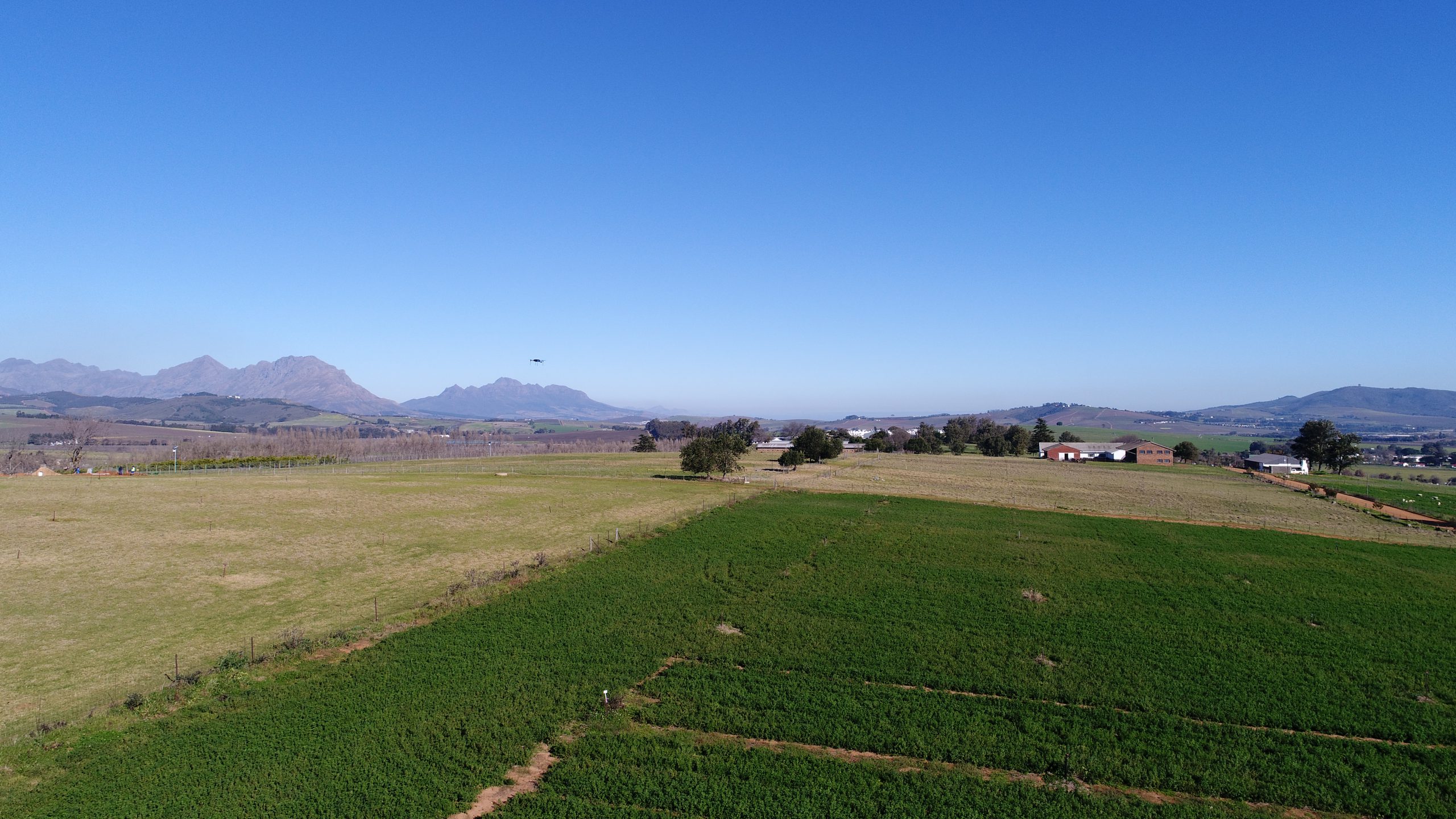
Situated in the Overberg district, the Tygerhoek Research Farm serves the areas around Caledon in the west, Swellendam in the east, Bredasdorp in the south and Riviersonderend in the north. Established in 1960, this research facility covers 560.38 ha, with approximately 500 ha of arable land.
Infrastructure and sheep resources flock
Animal Science Research
This farm is situated within a mixed-farming area (small grains and small stock to be precise), with rain throughout the year (Average total annual rainfall of 488mm).
With lucerne planted extensively as a dryland crop and part of a crop rotation system, the farm operates a no-till crop rotation system on arable land. These are not specifically used research projects. The sheep resource flocks maintained at the Tygerhoek Research Farm are fine wool Merinos and the crossbreeding resource flock.
Plant Science Research
With Dr. Johann Strauss leading research on long-term crop rotation, conservation and regenerative agriculture research, several small grain and cropping systems research projects are currently underway. Farmers day is held annually, which presents the results of completed and ongoing research undertaken on Tygerhoek and other related trials in the Overberg region.
Annemarie van der Merwe facilitates a long-term trial to evaluate the effects of different degrees of soil disturbance on soil health within three crop rotation systems. The effects of zero-till, no-till, minimum-till, and conventional-till are compared in wheat monoculture, wheat/medic and wheat/canola/wheat/lupine systems.
The Tygerhoek research farm has hosted several studies on Merino sheep with historic data and pedigrees dating back to the late 1960’s. The farm supported studies on direct and correlated responses to selection for clean fleece weight while keeping fibre diameter at the same level over a study period of 40 years from 1970-2009. At present, the farm maintains the Tygerhoek Fine wool Merino Research flock, a ‘proof of concept’ sheep breeding experiment that stems from a population with a pedigree dating back to the 1990’s and descended from the well-known fine wool research flock at Cradock. This project focuses on breeding for lower fibre diameter without seriously sacrificing performance in reproduction and other economically important traits. The flock regularly receives the highest wool price at the auction where its wool is marketed and maintains an average fibre diameter of below 14-micron in its hogget replacements.
It is also one of the very few flocks in the country with a comprehensive recording program for the so-called ‘difficult to measure’ fitness traits, including faecal worm egg count, breech flystrike incidence and associated traits. The Tygerhoek flock has also been a key population in the WCDoA sheep genotyping scheme. In this capacity, it was one of five research flocks used to validate the benefit of genomic information in South African sheep. Other recent research projects use historic data to study genetic aspects of reproduction and lamb survival, as well as the possible effect of heat stress on ewe conception. It is currently participating in projects attempting to do across flock evaluations for nematode resistance, a first step toward finding ways in which information generated in research flocks under institutional control can be leveraged to directly benefit genetic evaluations of fitness traits in industry.
Meet the Tygerhoek team
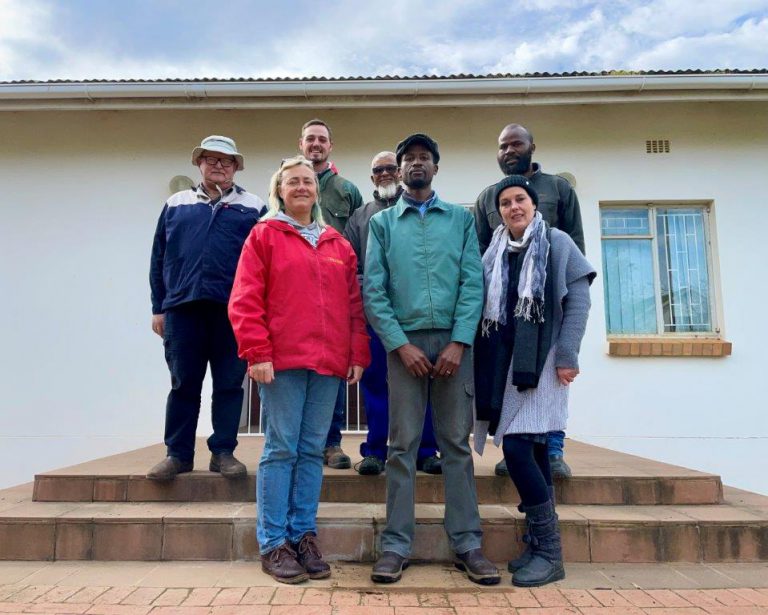
Front row left to right: Lisa Smorenburg: Scientific Technician, Lesiba Mabitsela: Research Farm Co-Ordinator and Kate Breytenbach: Administrative Clerk. Back row LTR: Willie Langehoven: Scientific Technician, Jaco Engelbrecht: Intern, Leon Petersen: Farm Foreman and Dr C Baker: Scientific Technician. Not pictured here is Werner Gouws – Veterinary services.
